


BOPP film is used every day in cigarette packs, adhesive tapes, and food packaging — yet few people know how a bag of resin pellets becomes a roll of film.
Gels, streaks, uneven thickness, low surface energy, web breaks… most of the film defects that frustrate downstream converters are planted in the production stage.
This article walks through the BOPP production process in one flow, then reviews the eight most common defects and how to trace them — because to use a film well, you first have to understand it.
1. From Resin Pellets to a Jumbo Roll: The Seven-Step Process
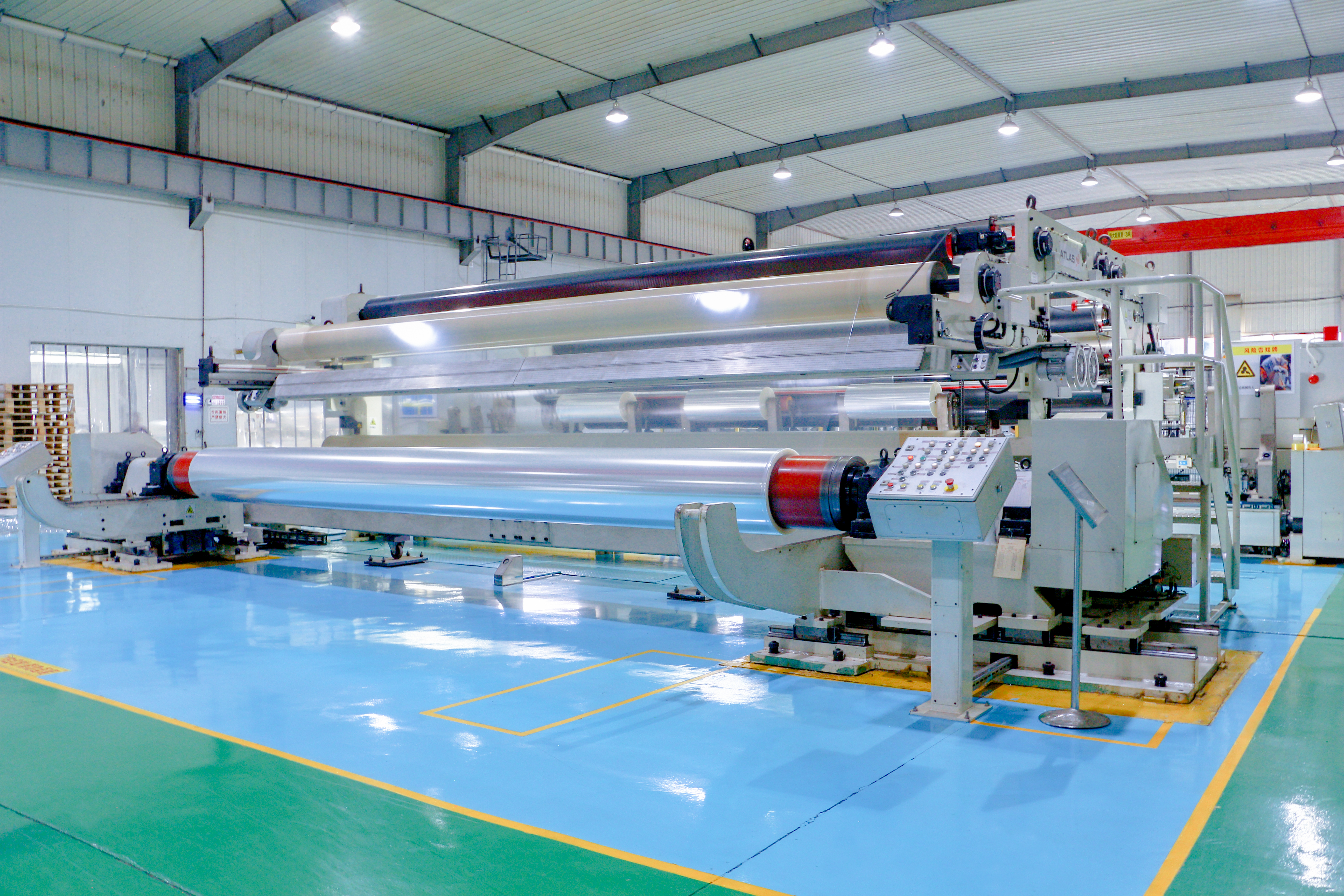
Producing BOPP film is, in essence, a process of making polypropylene molecules "line up." Through biaxial orientation, the molecular chains align regularly in both the machine and transverse directions — which is what gives the film its clarity, stiffness, and dimensional stability. The full process runs in seven steps:
Raw material preparation: homopolymer PP resin (MFI 3–8 g/10 min) blended with slip, anti-static and other additives according to the formulation
Extrusion and casting: the melt is plasticized at 200–250 °C, extruded through a T-die, and quenched against a 20–30 °C chill roll to form a 1–2 mm sheet
Machine-direction orientation (MDO): preheated to 100–120 °C, stretched 4–6× in the machine direction, then cooled to set
Transverse-direction orientation (TDO): stretched 8–10× at 120–140 °C in a tenter frame, then heat-set at 140–160 °C to relieve internal stress
Corona treatment: high-voltage discharge oxidizes the surface, raising surface energy from about 30 dyn/cm to 38–42 dyn/cm — a decisive factor for the adhesion of tapes and printing inks
Drawing and winding: edge-guided winding into jumbo rolls (4–8 m wide), followed by 24–48 hours of conditioning so internal stress relaxes and the surface energy stabilizes
Slitting and packaging: slit to order, inspected for thickness, width, appearance, and surface energy, then packed for storage

2. Where Film Defects Come From: The 8 Most Common Defects and How to Trace Them
Once the process is clear, tracing defects becomes much easier — nearly every film defect has its origin somewhere in production. The eight most common:
Gels (fisheyes / hard specks): transparent hard specks on the film surface. Usually caused by incompletely melted resin, cross-linked degradation, regrind contamination, or a broken screen pack
Uneven thickness: thickness variation across or along the web beyond ±2 μm. Often related to die gap, chill-roll temperature, stretch ratios, and winding tension
Streaks: longitudinal bright or dark lines. Mostly caused by die-lip defects, chill-roll scratches, or dirty stretch rolls
Insufficient or decaying surface energy: surface tension below 38 dyn/cm. Check the corona power, but also watch for slip-agent blooming and over-aged stock
Web breaks during stretching (film breakage): breaks during production or easy tearing in use. Focus the investigation on stretching temperature, stretch ratio, and resin contamination
High haze: a cloudy film with poor clarity. Usually related to insufficient sheet cooling at casting, or stretching / heat-setting temperatures that are too high
Excessive shrinkage: unstable dimensions after heating or storage. Common causes include insufficient heat-setting, excessive stretch ratio, and excessive winding tension
Slip-agent blooming: a greasy white frost and tackiness on the film surface. Excessive slip-agent dosage, high storage temperature, or accelerated migration after corona treatment can all trigger it


3. A Good Film Is "Managed": Ten Metrics, Checked Batch by Batch
At Shiner, whether a film is good enough is ultimately decided by ten key quality metrics: thickness, basis weight, haze, gloss, heat shrinkage, coefficient of friction, elastic modulus, heat-seal temperature and strength, abrasion resistance, and anti-static performance — each verified batch by batch against the corresponding national-standard test method.
Once the film reaches the customer, handling still affects packaging quality. Three recommendations:
Storage: keep the film below 30 °C, away from direct sunlight and heat sources
Acclimation: let the film adapt to the workshop's temperature and humidity for at least 24 hours before use — machine-running stability will improve noticeably
Changeovers: when changing auxiliary materials (especially the printed label paper) or switching to a different film thickness, adjust the equipment promptly
4. A Technical Observation Worth Noting
The industry often attributes cigarette packs becoming "tight and distorted" to the film's "post-shrinkage." In exchanges with customers, Shiner's technical team has found that films with a shrinkage rate within 5.5% show virtually no shrinkage after heat-sealing; only above 5.5% does a noticeable body-hugging shrink effect appear. Finished cigarette packs also expand during storage as internal stress relaxes — so film "post-shrinkage" is often not the primary cause of pack distortion. Good packaging results from the combined effect of film performance and equipment adjustment.
Understand the Production, and You Use the Film Better
If you encounter gels, web breaks, surface-energy decay, or similar issues in production, feel free to leave a comment below, or contact the Shiner technical team to discuss.
-
Hainan Shiner Industrial Recognized as "Manufacturing Single Champion Enterprise"
On February 25, 2026, the Hainan Provincial Department of Industry and Information Technology officially announced the first cohort of "Hainan Provincial Manufacturing Single Champion Enterprises." Hainan Shiner Industrial Co., Ltd.

2026-02-26
-

On July 22, 2026, the 2nd Thailand-China Cooperation Expo opened in Bangkok, featuring 270 premium enterprises and 500 booths focused on green manufacturing, new materials, and new energy. Hainan Shiner Industrial Co., Ltd. and Hainan BNK New Materials showcased their high-end film products. Thai Prime Minister Anutin Charnvirakul and the Chinese Chargé d'Affaires attended the opening ceremony, emphasizing cooperation and an open investment environment. Hainan Shiner's films, including eco-friendly packaging options, are solvent-free and meet international standards. The company engaged with Thai buyers, tailoring solutions and reaching preliminary cooperation intentions. The Expo will be annual event, and Hainan Shiner aims to deepen ties with ASEAN partners.
2026-07-24
Contact Us


Hi-Tech Zone, Hainan, China
Email:zhuhaiyan@shinerinc.com
Phone/WeChat/WhatsApp: +86 136 1759 3999
Tel: +86-0898-6858 1104
Fax:+86-0898-6858 5861